

 Posts


Talk about Peak Oil and the end of our highway travelin’ ways and you invariably get handed the mantra, “technology will save us.” We have this illogical and I’d add, pathological, faith in the ability of technology and mankind’s ingenuity. Take for instance the irrational belief so many Americans (and Europeans?) have in the free market to save our asses.
While I’d love to believe that some scientist will discover another substance that will give us 150 years of affluence and unlimited growth, I’m dubious about that epiphany occurring. Actually, I’m not sure our planet can take another 150 years of progress, or even another 15 years of our current abuse of the environment.
Human beings, with our unfounded arrogance and belief in our superiority, continually hold onto hope that science and technology is capable of solving every problem. Did you say global warming? Not a problem—we’ll just create new ways to cope with rising tides, increasing temperatures and frequency of natural disasters and approaching pandemics. Many in the scientific community, puffed up with pride in their perceived ability to forecast trends and shifts in climate, thought global warming would increase storms and consequently wind. As a result, there was a flurry to build windmills in the Netherlands and Germany to harness this abundance of natural energy and turn it into electricity. There is only one problem—these scientists apparently were wrong!
New research shows scientists could have been wrong when they forecast years ago that global warming would cause more storms and wind in northwestern Europe, Albert Klein Tank of the Royal Netherlands Meteorological Institute (KNMI) told Reuters.
"We said that 10-15 years ago and what we see in the observations is that the climate is warming but the number of storms is actually decreasing," said Klein Tank, who leads a team making climate scenarios for the Netherlands.
"We don't have a good explanation for that," he told Reuters in an interview on Wednesday.
It’s hard for us to accept that we don’t have all the answers. In an age of reality television and documented decreases in our cognitive capabilities, humans continue to believe that someone has the capability to figure things out. Despite the evidence that most humans have all they can handle trying to find their way to work in the morning, they continue to prostrate themselves to the gods of science and technology. Meanwhile, evidence clearly indicates that the future may not be as rosy as so many hoped for.
Thursday, October 27, 2005


Wednesday, October 26, 2005
Frank talk for the left
Lately, I haven’t felt particularly driven to write. That’s odd for me, as I have managed to put up content on both of my blogs fairly consistently. Maybe it’s the post-publishing blues, or the depressing weather. Possibly, the reason might be the inevitable need to follow-up one’s first book with another scintillating release. Being a writer who seems doomed to turn out niche books, that last reason appears dubious at best—there really isn’t any pressure at all to turn out another book that a 1,000 people might read, if I’m lucky.
While I haven’t been writing regularly, I have tried to do a bit more reading. I just finished Joshua Frank’s Left Out! How Liberals Helped Elect George W. Bush (Common Courage Press, 2005). A writer who contributes to such leftist muckraking rags as Counterpunch, Z Magazine and Earth First! Journal, Frank uses his allotted space to dissect the failed reasoning that gives us a choice of the lesser evil each election cycle.
Showing that the Democrats have marched to the same corporate beat as the Republicans for much too long, Frank peels back the façade of our two-party disaster and honestly looks at the options, moving forward, post-2004. Refusing to live in the land of denial that so many progressives have escaped to, Frank squarely lays the blame for George W. Bush’s reelection where it rightfully belongs—squarely on the door step of the Democrats. Not allowing the ABB (Anybody but Bush, in case you’ve forgotten) crowd any wiggle room, Frank writes, “I certainly don’t buy that this election was stolen like so many liberals are convinced. But hypothetically, if election ’04 was rigged, it should never have been close enough for Bush to steal. John Kerry should have won by a landslide. The Democrats simply failed to distinguish themselves on a host of critical issues.”
Frank spends a good portion at the beginning, deconstructing the myth of Howard Dean as progressive savior. Showing just how far to the right Democratic ideals have shifted, Frank clearly portrays Dean as the craven politician that he is—worse yet, he’s nothing more than a run-of-the-mill governor, a political rerun of the same show and sponsors that gave us Gore, Lieberman, Kerry, Clinton, etc. Yet, progressive Democrats, desperate for someone to lead them out of the swamp of triangulation and welfare reform (thank you, Bill Clinton), hitched their wagon to the Dean pony. Once that sideshow crashed and burned, then it was off to the main attraction—the sleep-inducing main feature of Kerry/Edwards.
The book is much more than just a bashing of Howard Dean, however. For someone like me, a registered Independent who often is enticed over into the two-party camp every four years, Frank was just what the doctor ordered. Recognizing that I’ll never get what I want by voting for what I don’t want, Frank clearly delineates what our strategy needs to be—working at the grassroots level, building third parties like the Greens and electing candidates to local office. Cynics (of which I am an honorary member) will say that third parties don’t stand a chance. That reason has been used quite successfully by our corporate puppet-masters to keep us in line with the two-party charade they’ve left us with. Yet, I don’t believe we have much of a choice, unless we are content to continue down the road of political cronyism, unending war, and media confusion.
On my most optimistic days, I hold out this illogical hope that a third party—one that acted with vigor, intent and possessing stamina—might come along and run a candidate that offered clear choices to voters. I imagine the millions of disenfranchised voters turning out and voting in droves for someone who offered real, tangible options, not the same old warmed over ideas of our two-party plutocracy. A young Ralph Nader, with charisma? Of course, there is the small issue of our winner-take-all, geography-based, political system, that assures us of the lesser of two evils every four years. Instant run off voting (IRV) might be a solution to lift us out of our current quagmire.
Frank is an unabashed supporter of the Green Party, although he takes them to task in his book, for their disastrous safe-state policy. He clearly shows in the book that Nader’s run in 2000 had the party moving in the right direction, only to see it implode with infighting, caused primarily by good and principled people succumbing to the ABB mentality that plagued so much of the left side of the political spectrum in 2004.
If you enjoy solid political writing, as I most assuredly do, then Frank’s book is a worthwhile read. At just over 200 pages, it’s an easy book to plow through over the weekend and I recommend it for clearing one’s head of faulty notions about our political process.
Friday, October 21, 2005
Grudge match
Well, it’s World Series time and there are no Red Sox, or even Yankees playing this year. Sadly, our beloved BoSox lost unceremoniously to the Pale Hose from the Windy City. My friend and fellow blogger, Wisdom Weasel alluded to my “grudge” in comments he made over at Listmaker’s site, so I thought I’d give the details, still fresh in my mind, after more than a decade.
Having lived about 45 minutes from the fabled working class city immortalized by the likes of Carl Sandburg and Studs Terkel, I have a fondness for this city by the lake. I even attended a White Sox game at U.S. Cellular Field, then known by its non corporate name of Comiskey Park. This might lead you to think I’d be rooting for the team that hasn’t won a World Series since 1917. I’d correct you with an emphatic, “hell no!”
You see, I hate the White Sox, or at least their organization. While it has undergone changes since the ill-fated game in 1993, attended by my then 9-year-old son, Mark, and my wife, Mary, the White Sox have always seemed like a second-rate professional franchise to me. Helping to cement that opinion, is that while I lived in the Midwest, the Sox were always the city's second team, regardless of how well they played and how poorly the beloved boys from Wrigleyville performed. At the time, the general manager was former major league journeyman pitcher, Ron Schueler, and the ownership consisted of Jerry Reinsdorf and little Eddie Einhorn, frequently vilified figures on the pages of the Tribune and Sun-Times.
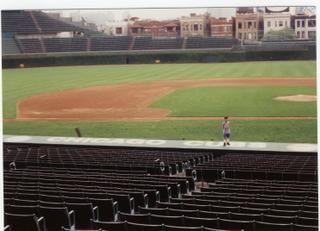
Having gone back for a visit to the birthplace of my son, we decided to settle for a Triple-A version of a major league game, since the beloved Cubbies were out of town. That didn’t keep us from visiting the hallowed ivy-covered confines of a ballpark that epitomizes what ballparks should be. Even though the team was on the road, management had the good sense to recognize that fans might want to come in and have a look around and even snap a few pictures.
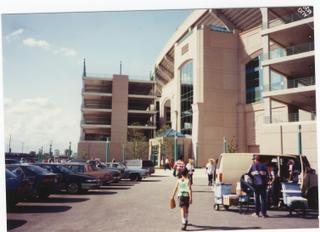
 Visiting the “new” Comiskey was a major disappointment, from the nosebleed seats in the upper deck, which made it impossible to enjoy the game, to the lousy concession food (and melted ice cream—you’ll have to ask Miss Mary about that one), but the ultimate insult was the way White Sox management treated the youngsters. Prior to the game, several hundred youngsters (including Mark) waited about 45 minutes for an autograph. This ’93 White Sox team was a young club on the rise with players like Jack McDowell, Frank Thomas, Robin Ventura (and of course, Guillen), so it should have been obvious to management that young fans might would want their autographs. Just as the players were coming to the dugout, this 14 or 15-year old usher with an attitude began telling the kids wanting autographs to move. He was rude and insulting and I went down to see what the problem was. I ended up getting into it with a couple of other older ushers and told them this was horsesh*t!
I couldn’t believe that a major league team, especially one with such a small following as the White Sox, would be so arrogant as to treat their fans, particularly young fans, in this manner. The entire time I lived in the Chicago-land area (from 83-87), the White Sox always played second fiddle to the beloved Cubs. Maybe this is why? The Cubs never treated their youngest fans like this and neither did the Red Sox or the Montreal Expos, all teams that Mark had received autographs at their home parks. We even have had meaningful exhanges with visiting players such as Dale Murphy, Tim Burke, Tom Glavine and even managers, such as Jimy Williams.
I wrote a long letter to Schueler and this former big league piece of sh*t didn’t have the decency to even acknowledge it. So yes, Weasel, I have a grudge against Ozzie Guillen and the Sox and I will be rooting for the Clemens-led Astros this weekend.

Having lived about 45 minutes from the fabled working class city immortalized by the likes of Carl Sandburg and Studs Terkel, I have a fondness for this city by the lake. I even attended a White Sox game at U.S. Cellular Field, then known by its non corporate name of Comiskey Park. This might lead you to think I’d be rooting for the team that hasn’t won a World Series since 1917. I’d correct you with an emphatic, “hell no!”
You see, I hate the White Sox, or at least their organization. While it has undergone changes since the ill-fated game in 1993, attended by my then 9-year-old son, Mark, and my wife, Mary, the White Sox have always seemed like a second-rate professional franchise to me. Helping to cement that opinion, is that while I lived in the Midwest, the Sox were always the city's second team, regardless of how well they played and how poorly the beloved boys from Wrigleyville performed. At the time, the general manager was former major league journeyman pitcher, Ron Schueler, and the ownership consisted of Jerry Reinsdorf and little Eddie Einhorn, frequently vilified figures on the pages of the Tribune and Sun-Times.
Having gone back for a visit to the birthplace of my son, we decided to settle for a Triple-A version of a major league game, since the beloved Cubbies were out of town. That didn’t keep us from visiting the hallowed ivy-covered confines of a ballpark that epitomizes what ballparks should be. Even though the team was on the road, management had the good sense to recognize that fans might want to come in and have a look around and even snap a few pictures.
 Visiting the “new” Comiskey was a major disappointment, from the nosebleed seats in the upper deck, which made it impossible to enjoy the game, to the lousy concession food (and melted ice cream—you’ll have to ask Miss Mary about that one), but the ultimate insult was the way White Sox management treated the youngsters. Prior to the game, several hundred youngsters (including Mark) waited about 45 minutes for an autograph. This ’93 White Sox team was a young club on the rise with players like Jack McDowell, Frank Thomas, Robin Ventura (and of course, Guillen), so it should have been obvious to management that young fans might would want their autographs. Just as the players were coming to the dugout, this 14 or 15-year old usher with an attitude began telling the kids wanting autographs to move. He was rude and insulting and I went down to see what the problem was. I ended up getting into it with a couple of other older ushers and told them this was horsesh*t!

I couldn’t believe that a major league team, especially one with such a small following as the White Sox, would be so arrogant as to treat their fans, particularly young fans, in this manner. The entire time I lived in the Chicago-land area (from 83-87), the White Sox always played second fiddle to the beloved Cubs. Maybe this is why? The Cubs never treated their youngest fans like this and neither did the Red Sox or the Montreal Expos, all teams that Mark had received autographs at their home parks. We even have had meaningful exhanges with visiting players such as Dale Murphy, Tim Burke, Tom Glavine and even managers, such as Jimy Williams.
I wrote a long letter to Schueler and this former big league piece of sh*t didn’t have the decency to even acknowledge it. So yes, Weasel, I have a grudge against Ozzie Guillen and the Sox and I will be rooting for the Clemens-led Astros this weekend.

Thursday, October 20, 2005
We own the airwaves
Payola—the practice of record companies paying to have their songs played on the radio—has made its way back after being dormant for decades. In 1960, Cleveland DJ Alan Freed was convicted of accepting $2,500 to play certain songs. While Freed insisted this “token of gratitude” didn’t affect what he played on the air, the FCC disagreed—it passed regulations banning the practice of payola.
Fast forward it to today. With radio consolidation, a handful of large radio conglomerates control stations across the country. From Clear Channel, which owns over 1,200 stations in 189 markets, to Infinity and other large conglomerates, commercial radio has had the lifeblood squeezed out of it. Whether you turn on the radio in Portland, Maine or Orlando, Florida, it all sounds the same. (Maybe that’s what Led Zeppelin meant by “The Song Remains the Same").
Free Press, a national, non partisan organization, is working to increase informed public participation regarding media issues, such as this one. They have a “crib sheet" posted on their website on payola, as well as many other issues pertaining to the media and public access of the airwaves. They have a map of stations currently under investigation.
In our own Portland, Maine market, WCYY, owned by conglomerate, Citadel Broadcasting, is currently under investigation. I happen to listen to their modern rock format when I’m out of reach of college stations from Bates or Bowdoin, or community radio such as WMPG in Portland. While ‘CYY’s format is derivative, the station does program some local music. Interestingly, if I hadn’t seen the Free Press page on payola, I would not have known anything about the investigation of a local station, which says quite a bit about our local paper, the Portland Press Herald. Actually, I cancelled my subscription to it because it just plain sucks! Possibly they ran that story in the last two weeks and I just missed it?
Media consolidation continues to be a major issue, as corporations controlling the airwaves and eliminating diversity of opinions, views, as well as entertainment is not a good thing. If you care at all about local access issues, I highly recommend the Free Press site for its content on this important issue.
Sunday, October 16, 2005
Saturday matinee
With another rainy weekend upon us, and a plea for more books from Longfellow Books in Portland, Mary and I headed into Portland. Recognizing that it had been awhile since we had attended a film at The Movies on Exchange Street, we decided to catch an afternoon matinee, the perfect foil for the blowing rain and generally inhospitable conditions, outdoors.
The movie on the matinee was Junebug, the new film from Phillip Morrison. Morrison, a NYU film graduate, has been receiving favorable reviews and generating comparisons to directors such as Jim Jarmusch and Gus Van Sant, with his first full-length feature film.
Junebug is a story about family and place of origin. Son, George, returns to his hometown in North Carolina with his new bride, Madeline. Madeline, an art dealer, with a gallery in Chicago, where she and George met, specializes in “outsider” art. They come to George’s hometown to visit the eccentric David Wark and his collection of uniquely strange Civil War paintings and artwork. The decision is also made to visit George’s family.
Morrison captures the tension of returns to one’s birth family, with the changes that accompany growth and maturation. Can one ever truly go home again—yes, but not without awkwardness and the realization that life is more than black and white choices.
George’s family and Morrison’s character study is refreshing. Avoiding clichés, without denying that they exist, the film captures the interesting family dynamic that exists for most of us. Madeline, British-born and sophisticated, does her best imitation of accommodating daughter-in-law. George’s mother, however, views Madeline with suspicion, bordering on contempt. George’s younger brother, Johnny, is an angry, brooding character, whose pregnant wife, Ashley, is so happy to have a new friend in Madeline.
The movie shows George’s rural roots, deeply steeped in the church, with a poignant scene of a church supper, where his former pastor asks George to sing a hymn. Probably, it's been years since George has embraced his southern Baptist faith, yet, after initial reluctance, gets up and performs an impassioned version of a well-known Christian hymn. His wife Madeline’s face is captured and you see elements of her recognition of a side of George that she hadn’t known.
With the original score for the movie written and performed by one of my favorite indie rock bands, Hoboken, New Jersey’s scenesters, Yo La Tengo, I found Junebug to be an indie film worthy of one’s attention.
Subscribe to:
Posts (Atom)