

 Posts


At least gimme' some music that's more original than the usual offerings circulating the commercial dial.
My winter doldrums have been chronicled and I'll not comment any more about them other than to say, I've been seriously lacking in the music department of late and I aim to remedy that immediately. It amazes me how quickly one's mood can improve by cutting of the the flow of cathode rays from the idiot box, and mixing in some music and some good reading material, or any reading material, for that matter.
It occurred to me, yesterday, how little music I've been listening to. One of my favorite times to spin some tunes has always been dinner time. Last night, up to my elbows in pasta and mixing salad greens, I dug out my copy of For A While, It Was Funny, from indie rock gods, the Karl Hendricks Trio. Hot Damn! I forgot how good wallowing in one's misery felt. This '96 release, on Merge, had been sitting, sadly forgotten, gathering dust on my CD shelves. I dug it out and cranked up the volume and my funk immediately dissipated!
Hell, I feel my productivity level just ramped up several notches with that one spin of a disc. Speaking of discs, check out Mark Schwaber's new CD, The Killing Card on the best little indie label there is, Pigeon Records. Schwaber has four songs up on MySpace for a preview. I've met Schwaber through my buddy, Jose Ayerve, of Spouse, as Mark plays bass for the band. An obviously talented songwriter in his own right, the new disc also showcases his guitar playing and skills at songcrafting.
Just like the book world, where many fine local, independent releases get ignored and bypassed by the latest formulaic offerings from the major publishing houses, indie rock, also, suffers from a similar climate. I recognize that Maine is part of a very fertile New England music scene, often obscured by the semi-talented poseurs pushed on us by major publications like Spin, Rolling Stone and others, bankrolled by the smoke and mirrors of unlimited marketing rolling down from deep-pocketed major labels.
In addition to Schwaber's new release, longtime Portland musician, Doug Cowan, has a new release out with the amazing Bullyclub. If you like well-written, intelligent songs, infused with a pop sensibility, with a bit of guitar crunch thrown in, then you can't go wrong with the Pigeon catalog and acts like Spouse, Bullyclub and Mark Schwaber.
Friday, February 24, 2006


Wednesday, February 22, 2006
Corporatizing another asset
There has been no shortage of commentary about the Bush administration's decision to turn over port security to a corporation, based in the Arab world. There has been a great deal of blather about the security risks this poses, and critics of the plan have been just as boisterous on the right, as on the left.
With any issue, I always find that what is being talked about away from the din and cacophony is worth paying attention to. John Nichols' blog at The Nation is a case in point. Rather than focusing merely on the security issues, Nichols looks at the issue of turning another one of our national assets over to a corporation and the consequences associated with this. As Nichols notes, the privitization angle has been sadly lacking in any of the MSM's coverage of this news story.
As Nichols writes, "The private firms that control so many of the nation's ports have not begun to set up a solid system for waterfront security in the more than four years since the September 11, 2001 attacks. And shifting control of the ports of New York, New Jersey, Baltimore, New Orleans, Miami and Philadelphia -- along with control over the movement of military equipment on behalf of the U.S. Army through the ports at Beaumont and Corpus Christi -- from a British firm, Peninsular and Oriental Steam Navigation Co., to Dubai Ports World, is not going to improve the situation."
I would have to agree with his points concerning this transfer of control of a vital aspect of our national infrastructure. There is more to this story than we are getting and Nichols gives us a solid starting for a deeper look into the matter.
Monday, February 20, 2006
Underwhelming the competition
While the Winter Olympics struggle to outperform reality TV and second-rate dramas like "Grey’s Anatomy," for ratings, some of us who are watching, are not terribly impressed with what we've seen, thus far.
My bone to pick isn’t necessarily with the athletic performances of most of the world's athletes, or the world class competition they provide for appreciative viewers. My issues are with both the way that NBC chooses to focus on select events, aiming for their highest possible primetime audience, and the underwhelming performance of the over hyped and cocky American athletes.
As for ratings, the 2006 Olympics in Turin, are the lowest rated winter games since 1988. Not that I really care whether General Electric and NBC take a financial bath. In a worst case scenario, I can always watch Canadian television, even if I can’t understand a word the French-speaking announcers utter.
Both the American and Canadian hockey teams have performed poorly, with the U.S. losing consecutive games to Sweden and Slovakia, and the progenitors of hockey, the Canadians, losing to Finland and world hockey power, Switzerland. While the U.S. has struggled often in international ice hockey competition, there have been moments of glory, none as unforgettable as 1980’s miracle on ice. Unfortunately, with the need to introduce professional players into the mix, beginning in 1998, the results have been underwhelming. Even on the women’s side, the highly-touted U.S. women’s team, expected to play for the gold medal, lost to an unheralded Swedish women’s team on Friday, in a shootout. The U.S. and Canada were thought to be the elite women’s teams in the women’s hockey pool, but Sweden, which almost didn’t send a team, rode the heroic goaltending of 19-year-old Kim Martin, to stun the U.S. women, who now play a consolation match with hopes of at least coming home with a bronze medal.
I watched most of the women’s U.S./Sweden match on Friday, before a power outage robbed me of the opportunity to see the overtime period and shootout, ultimately capture by the Swedes. I was able to see the ending, yesterday, as CNBC rebroadcast the game.
Clearly, the U.S. team was superior in talent, but time-after-time, they were unable to capitalize on scoring opportunities. At one point, they had a two person advantage, due to penalties, and had difficultly getting shots on net. Not to take anything away from the sensational play of Martin, and the gritty leadership of veteran forward, Maria Rooth, but like their male counterparts, the women’s team underperformed when it counted and winning a bronze isn’t even a sure thing for them, at this point.
It’s not hard to understand why much of the world resents the U.S., particularly when we arrive with our red, white, and blue cockiness and swagger and then get dominated by the likes of tiny Norway in many events, or, our ski team, with all its bravado and boasting, gets out medaled by a sister and brother team from Croatia.
Thus far, Janica and Ivica Kostelic have two medals, to team U.S.A.’s one, in Alpine skiing. Janica, who won a gold in Salt Lake City, in 2002, is coming off major knee surgery. Both she and her brother, Ivica, have had to struggle to compete at this level. Coming from a war-torn country, their father, Ante, often had to “hawk” skis and other prizes they had won from sponsors, just to put gas in their car, as they traveled around Europe to competitions.
While I’m obviously critical of much of the hype surrounding the U.S. team, there are a few athletes that march to their own drummer and transcend all the hype of the U.S. media/marketing machine.
One of these athletes is Shani Davis, the African-American speed skater who won gold in the 1,000-meter race on Saturday. Davis, who grew up on the South Side of Chicago, not exactly the hotbed of American speedskating, had been criticized by flag-waving, loudmouth, Chad Hedrick, of Texas, because Davis chose not to skate for the U.S. team in the relay event, focusing on his individual race instead. Davis finished with the gold and Hedrick, finished out of the medals, ending up a distant sixth.
I found it interesting how NBC chose to hype Hedrick, the stereotypical, white superstar, while totally ignoring Davis, until he won the gold. There has been very little on Davis, even after his gold medal in the 1,000. He still has an opportunity on Tuesday to race in the 1,500-meter race and could very well medal in that, also.
Maine's own, Seth Westcott, about as down-to-earth a person as you'll find on this international stage, wowed the world with his gold medal performance in the newest event, snowboarding's boarder cross.
Today, Bode Miller, who has been a major disappointment, thus far, races in the men’s Super-G, which NBC will broadcast this evening. While I’ve defended Miller and the criticized those who took issue with his 60 Minutes interview, I’m afraid Bode has gotten caught up in his own celebrity and has forgotten why many are interested in him in the first place. People are willing to overlooking loudmouth boors, if they can do something no one else can do—in Miller’s case, ski. If you are having problems making it down the mountain, then you end up being seen as an overbearing ass, instead of a world-class athlete. The former seems to be something that this year’s team has in abundance.
Thursday, February 16, 2006
Freeing up the dial
Community radio's beacon of the coast-WERU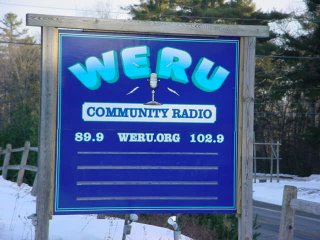
Land yachts make great receptors for free-form radio-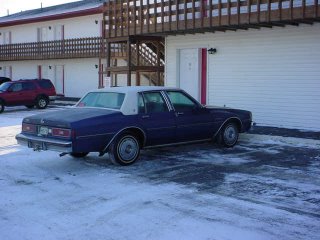 I’ve always been fond of radio with an eclectic bent. Growing up in the 1970s allowed me to experience FM radio that was truly free-form. Those of us who were privileged to listen to WBLM at that time know exactly what I’m talking about. Eclecticism and variety was the modus operandi for radio during this period, and it wasn’t limited to Maine, or even New England. This was the period before corporations sunk their claws into the fabric of broadcasting and being a DJ actually required some creativity and knowledge of music. It was an age when there truly were radio “personalities” in the truest sense of the word.
Of course, running up and down the radio dial today is an exercise in torture, with pre-programmed formats and playlists that leave little room for variance. The only redeeming aspects of radio in these parts are the community radio stations and a few low-power FM outlets (like Rockland's WRFR-LP).
A community radio beacon down the coast, is WERU, with studios located in East Orland. Whenever I’m within reach of their tower, I’m always envious of the listeners who can pull their signals in on a regular basis. I am aware that they simulcast on the web, but for me, radio is a habit that has always seemed most enjoyable and best listened to, while driving in a car, down some deserted stretch or road, with just you and the music keeping company.
On my way home, on Tuesday afternoon, I stopped by the WERU studios and taped a seven minute segment for their Voices program that will air at a later date. Radio host, Denis Howard, had received a plug about my book, When Towns Had Teams, from a listener, and had contacted me, offering me the opportunity to record a spot if I ever got down his way. This trip allowed me to mix some business with book promotion and we recorded a lively spot that should give the book a bit of a bump. It is welcomed, especially since a good deal of the subject matter (particularly chapter 6) transpires nearby. Furthermore, this area doesn’t have some of the media outlets and weekly publications that I’ve put to good use to market my book in southern Maine.
I have made a point to listen more regularly via the web, but it sure was good to pull in some unique and varied programming over my car radio for parts of two days, in my travels. With WERU holding freeform’s torch aloft in this area of the state, coupled with community stalwart, WMPG, in greater-Portland, Maine has two great community-based occupiers of the state’s radio dial.
Land yachts make great receptors for free-form radio-
 I’ve always been fond of radio with an eclectic bent. Growing up in the 1970s allowed me to experience FM radio that was truly free-form. Those of us who were privileged to listen to WBLM at that time know exactly what I’m talking about. Eclecticism and variety was the modus operandi for radio during this period, and it wasn’t limited to Maine, or even New England. This was the period before corporations sunk their claws into the fabric of broadcasting and being a DJ actually required some creativity and knowledge of music. It was an age when there truly were radio “personalities” in the truest sense of the word.
Of course, running up and down the radio dial today is an exercise in torture, with pre-programmed formats and playlists that leave little room for variance. The only redeeming aspects of radio in these parts are the community radio stations and a few low-power FM outlets (like Rockland's WRFR-LP).
A community radio beacon down the coast, is WERU, with studios located in East Orland. Whenever I’m within reach of their tower, I’m always envious of the listeners who can pull their signals in on a regular basis. I am aware that they simulcast on the web, but for me, radio is a habit that has always seemed most enjoyable and best listened to, while driving in a car, down some deserted stretch or road, with just you and the music keeping company.
On my way home, on Tuesday afternoon, I stopped by the WERU studios and taped a seven minute segment for their Voices program that will air at a later date. Radio host, Denis Howard, had received a plug about my book, When Towns Had Teams, from a listener, and had contacted me, offering me the opportunity to record a spot if I ever got down his way. This trip allowed me to mix some business with book promotion and we recorded a lively spot that should give the book a bit of a bump. It is welcomed, especially since a good deal of the subject matter (particularly chapter 6) transpires nearby. Furthermore, this area doesn’t have some of the media outlets and weekly publications that I’ve put to good use to market my book in southern Maine.
I have made a point to listen more regularly via the web, but it sure was good to pull in some unique and varied programming over my car radio for parts of two days, in my travels. With WERU holding freeform’s torch aloft in this area of the state, coupled with community stalwart, WMPG, in greater-Portland, Maine has two great community-based occupiers of the state’s radio dial.
Down the coast of Maine


(Top to bottom)
Photo 1: Getting my bearings
Photo 2: The blueberry barrens outside Machias.
Photo 3: The Road to Nowhere (aka, Lubec).
Photo 4: Helen's: Home of Maine's best blueberry pie.
Maine seems like a large state, especially when you travel east and west. In reality, however, Maine’s land mass is 39th in size, compared to the other 49 states. This fact alone makes me appreciate the sheer size of the rest of the country.
Downeastern Maine has its own folklore and the deeper you drive “down” the coast, the more parochial and distinct the area becomes, particularly compared to trendy Portland, the state’s hub. Washington County, Maine’s easternmost county, has the dubious honor of being the poorest of the state’s 16 regions, or counties.
Tucked away from the rest of Maine, the state’s most geographically isolated area is also known for its distinctive culture, traditional industries such as fishing and logging, as well as blueberry barrens—it also has the state’s highest unemployment rate, which in 2002, was touching 9 percent, double the state average.
While the natural beauty of the region is breathtaking, most of the inhabitants are too busy scratching out a living to pay particular attention.
As I began my 56 mile trek towards Machias, on barren stretches of U.S. Route 1, which leaves Ellsworth, the summer’s tourist mecca, for the deeper regions and points eastward, I passed the entrance to Acadia National Park, New England’s only representative of the nation’s system of parks. As a native Mainer, I’ve only been up Cadillac Mountain once in my life. I rarely venture near Ellsworth, or other so-called tourist attractions in the summer. Partly due to my distaste of crowds, but also, the summer is usually taken up with other pursuits. Even picturesque Bar Harbor, a magnet for the summer hordes from away, is a place I’ve only been to a handful of times, most often, in the fall, or dead of winter, when the tourists have scurried back to their places of origin and commerce.
Many Maine writers have attempted to capture this part of the state. None comes closer, in my opinion, in capturing the quirks, culture and unique way of life of the region, than the late Ruth Moore. Born in 1903, Moore wrote about the people and places that even today, still evokes some sense of distinction, in a culture increasingly homogenized and processed. While Moore is often characterized as a regional writer—a label she came to detest—her writing captures the geographical place of her birth and life, as well as any writer before her, or since.
As often happens with writers, Moore’s reviewers often missed her social critique and commentary on Downeast life that characterized her works. Like Sarah Orne Jewett before her, Moore’s characters and places in her books, stood as testaments to a rural way of life, straining to maintain a foothold, in the face of encroaching industrialization.
On my return journey from Machias, I stopped in Ellsworth, Tuesday afternoon, and found the town library. Between appointments, I spent about 30 minutes reading some correspondence, in the form of letters, that have been gathered from Moore’s life. High Clouds Soaring, Storm Clouds Driven Low: The Letters of Ruth Moore (Blackberry Press, 1993) contains over 500 pages of correspondence that Moore had with writers, editors, and other local figures throughout her life. Edited by a fine local writer in his own right, Sanford Phippen, a regionalist and a contemporary of other writers, like Carolyn Chute.
My trip was long and the initial driving tricky, from the aftermath of Sunday’s northeaster, but it was worthwhile on several fronts. It provided some needed income from my contract marketing work that I do for Maine’s premiere help wanted website. The trip also afforded me a chance to visit an area of my home state that I don’t see often enough; plus, I dropped off some books, and taped a segment for a vibrant community radio station, WERU, in East Orland. And maybe the best part, I got to partake of Helen’s Blueberry Pie in Machias, Monday night. If you are ever in this part of the state, drive through town and look for Helen’s Restaurant on the right. With down home cooking, fresh seafood and unbelievable reasonable prices, it’s better than most of the upscale and overly-hyped places of southern Maine.
Subscribe to:
Posts (Atom)